
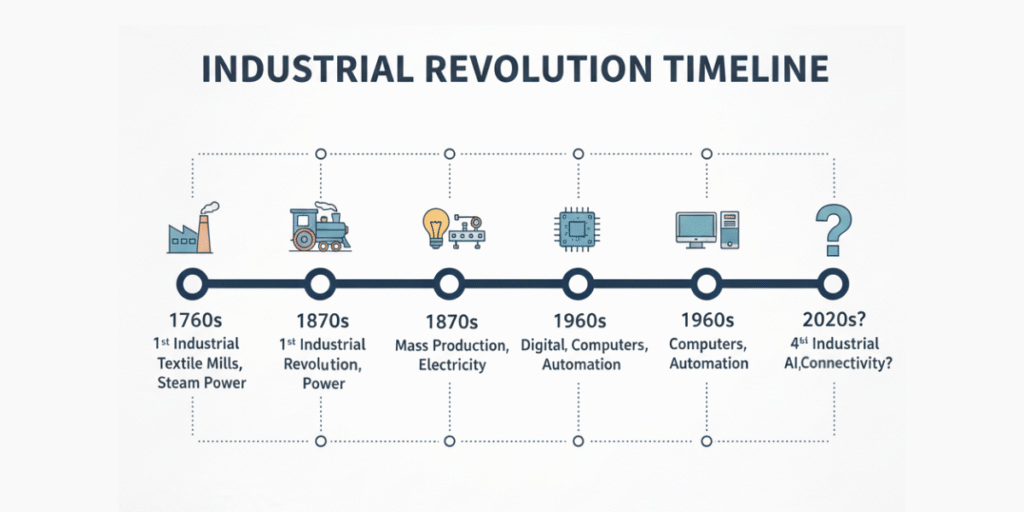
- Is AI the fourth Industrial Revolution?
- What Do We Mean by “Revolution” Anyway?
- So… Does AI Fit the Definition of a Revolution?
- So Is AI the Fourth Industrial Revolution?
- Why it can be misleading to say “AI is the Fourth Industrial Revolution”
- A More Precise Way to Put It
- The Fourth Industrial Revolution
- A Balanced Conclusion
- Five load-bearing claims (and sources)
Is AI the fourth Industrial Revolution?
Have you ever opened the news, seen headlines about “AI changing everything,” and wondered… is it really that big of a deal? Or is it just another tech trend?
If you’ve been curious but also a little overwhelmed (totally normal), this guide is for you. We’re going to break down what a revolution actually means, how historians define it, and whether AI truly fits that definition with real world examples.
By the end, you’ll have a clear, confident understanding of where AI sits in the big picture of human progress.
What Do We Mean by “Revolution” Anyway?
Before we decide whether AI is a revolution, we need to understand what qualifies as one. Historians don’t throw this word around lightly. A revolution isn’t just “new tech” or a “cool upgrade.” It’s something much bigger.
Across history, three things keep showing up whenever a true revolution happens.
1. A revolution transforms systems, not just tools
A real revolution doesn’t simply upgrade the gadgets people use. It changes the entire logic of how society works.
Take the steam engine. It didn’t just make trains run faster. It reshaped manufacturing, reorganized labor, boosted global trade and completely changed how goods were produced. A tool becomes revolutionary when it changes the system around it.
2. A revolution spreads across many industries
Small inventions stay in one field. Revolutions break out of their original category.
Electricity is one of the clearest examples. It transformed homes, factories, transportation, communication and city planning. It was everywhere. When a technology crosses industry boundaries, something big is happening.
3. A revolution reshapes daily life and social structures
Industrial revolutions don’t just affect businesses. They influence how people live, learn, work and even vote. They can change education, job types, city layouts and economic classes. Sometimes they even push governments to create new rules or upgrade old ones.
Put simply, a revolution isn’t a single invention. It’s a phase of interconnected change that alters how society functions.
So… Does AI Fit the Definition of a Revolution?
Now that we know what a revolution looks like, let’s apply the same lens to artificial intelligence
1. Is AI transforming systems rather than individual tasks?
Yes. In fact, this is where AI is most powerful.
AI isn’t just writing emails or generating marketing ideas. It is reshaping how entire industries plan, produce and deliver value.
For example:
– Supply chains use AI to predict shortages before they happen
– Hospitals use AI to interpret scans and assist doctors
– Schools use AI to personalize lessons for students
– Governments use AI systems to deliver public services and detect fraud
These aren’t small productivity boosts. They signal a shift in how systems operate.
2. Is AI spreading across sectors?
More than almost any technology in recent decades.
You can find AI quietly running things behind the scenes in:
– Banking
– Retail
– Transport
– Logistics
– Biotech
– Media
– Manufacturing
– Cybersecurity
– Creative Industries
Few technologies since electricity have reached so many corners of the economy this quickly.
Is AI reshaping social, economic and political life?
More than almost any technology in recent decades.
You can find AI quietly running things behind the scenes in:
– Banking
– Retail
– Transport
– Logistics
– Biotech
– Media
– Manufacturing
– Cybersecurity
– Creative Industries
Few technologies since electricity have reached so many corners of the economy this quickly.
Absolutely, and often in ways people are only starting to understand.
AI influences:
– The types of jobs available
– Bow people learn new skilles
– Copyright and creative rights
– Fairness and bias in decision making
– Election information and misinformation
– privacy and surveillance practices
These aren’t small side effects. They’re social level changes we’ve seen in every major industrial revolution.
Based on these criteria, AI looks and behaves like a revolutionary force.
Key Impacts
Work and jobs
AI may replace some repetitive tasks, but it also enhances a lot of existing roles and creates brand new ones. Think of how the personal computer eliminated typing pools but created IT departments, software jobs and digital marketing.
The final outcome depends on how governments and companies respond with training programs, safety nets and support for workers.
Business models and industry structure
Companies with strong access to data, computing power and AI talent have a significant advantage. This can widen gaps between early adopters and everyone else. We already see this in cloud companies, chip manufacturers and logistics giants that use AI to optimize every part of their operations.
Governance and ethic
AI raises questions about fairness, transparency and accountability. How do we prevent biased algorithms from influencing loans or job applications? How do we stop deepfakes from damaging public trust? The rules written in the next few years will determine how safe and beneficial AI becomes.
So Is AI the Fourth Industrial Revolution?
The honest answer is a little more nuanced than yes or no.
The “yes” argument
AI has the depth, reach and transformational energy of past revolutions. It reorganizes systems, spreads across sectors and triggers major social changes. In that sense, AI fits the classic pattern perfectly.
The “not exactly” argument
But revolutions aren’t caused by one technology alone. They happen when several technologies advance together and reinforce one another.
The current period includes:
AI
Robotics
The Internet of Things
Big Data
Cloud Computing
Advanced Manufacturing
Biotechnology
AI is the engine that powers many of these changes, but it is not the entire ecosystem.
Why it can be misleading to say “AI is the Fourth Industrial Revolution”
- There are three reasons scholars caution against that phrasing:
The fourth industrial revolution is a convergence of many technologies working together. AI doesn’t operate alone. It relies on sensors, networks, specialized chips and advanced computing systems. - Revolutions take decades to fully unfold. We’re still in the early chapters, and progress is uneven across countries and industries.
- Social and political choices shape the final outcome. Without good policies, AI could widen inequalities or create new risks.
A More Precise Way to Put It
AI is the engine powering today’s transformation.
But the revolution itself is the entire system created when AI merges with robotics, sensors, networks and biological technologies.
That full system has a name:
The Fourth Industrial Revolution
Klaus Schwab popularized the term to describe the blending of digital, physical and biological technologies. It’s not one invention, but a deep shift in how we work, produce, communicate and live.
Here’s what forms the full “vehicle” of this revolution:
Artificial intelligence
The learning and decision-making layer.
Advanced robotics
Machines that sense their environment and respond intelligently.
Example: warehouse robots that navigate on their own.
Internet of Things
Networks of devices collecting and sharing real time data.
Example: smart meters, connected cars, industrial sensors.
Cloud and edge computing
The infrastructure that powers large models and real time automation.
Advanced manufacturing
From 3D printing to autonomous production lines.
Biotechnology
Where digital tools meet genetics and synthetic biology.
Together, they form the broader transformation we call the Fourth Industrial Revolution. AI is the most visible part, but the revolution is the combined shift created when these technologies work together.
A Balanced Conclusion
AI is a central driver of the Fourth Industrial Revolution, but it isn’t the revolution on its own. The shift we’re experiencing comes from AI plus robotics, sensors, networks, and breakthroughs in biological science.
AI is the most powerful and transformative engine inside that larger system, but the vehicle is much bigger than one technology. (Key supporting sources: WEF, McKinsey, review literature). World Economic Forum+2McKinsey & Company+2
Five load-bearing claims (and sources)
Below are the most important claims in the article with their supporting citations:
- The Fourth Industrial Revolution is a systems-level shift that includes AI as a core driver. World Economic Forum+1
- AI’s recent advances (large models, generative AI) have created qualitatively new capabilities that accelerate transformational change. Forbes+1
- AI can significantly raise productivity and reshape industries — but benefits may concentrate among firms that control data and compute. McKinsey & Company+1
- There is disagreement among researchers about AI’s net effect on jobs: augmentation vs displacement is an open empirical question mediated by policy. arXiv+1
- The social, political, and regulatory response — not technology alone — will determine whether this “revolution” benefits many or few. The New Yorker+1
Leave a Reply